
News & Articles

FUEL DILUTION: Fuel Injector MTBF – Equal Failure Rates Can Create Unequal Consequences (Part 9 of 10)
Article by William Gillette (LogiLube, LLC)
For diesel powered off-highway applications, actual fuel injector lifespan fluctuates heavily based on a few distinct variables:
-
Duty Cycle: Constant high-load mining environments or earth-moving cycles exert more pressure on solenoids and plungers, which generally reduces time between failures compared to standby stationary generators.
-
Fuel Quality & Filtration: The single biggest factor influencing MTBF. Contamination, water, and low-lubricity fuels drastically reduce injector lifespan. Most heavy-duty off-highway engines use advanced filtration (like specific water separators) to hit their intended hours.
-
Injection System Type: Traditional Mechanically-actuated Electronically-controlled (MEUI) systems traditionally boast slightly higher raw robustness under field environments. Advanced High-Pressure Common Rail (HPCR) systems used in modern engines provide cleaner emissions and better fuel economy but depend on highly precise, high-pressure components that are more sensitive to fuel particulates.
Many reliability engineers use reliability statistics and metrics to define the reliability of a component. However, not all MTBF metrics are the same.
Lifespan vs. Application
In a massive 116 Liter, 20-cylinder diesel engine powering a 340T mining haul truck, the injector MTBF and targeted replacement intervals scale according to how hard the engine is pushed. The MTBF for its fuel injectors typically ranges from 6,000 to 10,000 operating hours under normal working conditions.
However, the highly sensitive, high-pressure Common Rail fuel system (up to 2,200+ bar / 32,000+ psi), uses injectors that have tighter tolerances than older mechanical systems, making their lifespan highly dependent on operating environment and maintenance. In the demanding mining environment, high dynamic load factors, variable throttle cycles, and exposure to airborne dust accelerate component wear. The MTBF/replacement window is 6,000 to 8,000 hours.
Primary Causes of Premature Failure
If injectors fail significantly before the 6,000-hour mark, it is almost always traceable to one of three common systemic stressors:
-
Particulate Abrasive Wear: Because the Common Rail system operates at extreme pressures, micro-particles bypass inferior filters and erode the internal control valve seats. This triggers high fuel return flow, leading to hard starting or low rail pressure codes.
-
Fuel Lubricity Issues: Ultra-Low Sulfur Diesel (ULSD) or poorly treated biodiesel blends lack natural lubricity. This causes internal scuffing of the plunger, leading to sticky injectors or sluggish solenoid response.
-
Water Contamination: Water passing through the nozzle tip flashes into steam instantly. This leads to tip cracking or cavitation erosion, which corrupts the fuel spray pattern and causes cylinder wash or excessive smoke.
Size Matters
Depending on the environment and application, MTBF values can have drastically varying consequences. This also relates to the types of failures which occur in diesel engines. For instance, a fuel injector failure can mean different ratios of reduced power for a 6 cylinder versus a 20-cylinder diesel engine. If these are placed in different environments, the MTBF can also escalate, as one failed fuel injector for a 20-cylinder diesel engine in an open pit mine will not have as many detrimental effects as one failed fuel injector of 6 cylinder diesel engine in an underground mine.
As shown in the figure below, one fuel injector failure does not have the same consequences as applied to different engines in different environments. The smaller the engine (less cylinders), the larger the impact of one damaged fuel injector (16.7% loss of power) compared to the impact of one damaged fuel injector for a larger engine (only 5% loss of power). While the numbers may seem small for the loss of power, they have a significant effect on the delays in production, loss of operational hours and safety risks.

This also affects how long each engine takes to reach the fuel dilution condemning limit of 4.0%. With both engines operated at 50% rated load, experiencing a 10% fuel dilution rate, they took different times to reach the fuel dilution condemning limit as shown below.

Volvo TAD1683VE Diesel Engine - A single failed fuel injector leaking just 10% reaches 4.0% FUEL DILUTION (condemning limit) in 1:40 hours while operating at 50% rated load.
CAT C175-20 Diesel Engine - A single failed fuel injector leaking just 10% reaches 4.0% FUEL DILUTION (condemning limit) in 29:04 hours while operating at 50% rated load.
Determining the Reliability of the Engine
The operational sensitivity of the diesel engines is one key factor which should be taken into consideration. This depends on:
-
Engine architecture
-
Sump volume
-
Ventilation environment
-
Emissions sensitivity
-
Production dependency
These factors all play a role in determining the overall reliability of the engine. Using reliability statistics alone (especially only MTBF) cannot determine the overall reliability of the engine.
Reliability statistics paired with operational sensitivity can provide a better picture of the state of the equipment compared to looking at the MTBF in isolation. With smaller MTBFs, there should be continuous monitoring of the oil to determine if the levels of fuel contamination are being exceeded below the projected MTBF values. This is where the Autonomous Fluid Intelligence™ utilizing the SmartOil® G3 Edge-AI Brain™ really changes the game for operators.
Even with smaller MTBFs, the operational factors and risks should also be considered when determining the best method of monitoring the health of the oil. Especially for underground mining, the consequences which can occur due to a failed fuel injector far outweigh the cost of downtime or the negative impact of emissions as shown below.

With the SmartOil® G3 Edge-AI Brain™ processing multi-domain real-time data feeds from 3rd party sensors, it becomes easier to monitor any changes in the fluid and begin preparations for maintenance before these risks are realized. LogiLube’s proprietary algorithms aggregate the real-time data feeds to continuously calculate the remaining-useful-life (RUL) of the engine oil.
Through exception sampling, the Edge-AI Brain™ can detect small changes in the viscosity or dielectric to trigger an oil sample to be sent off to the lab for confirmation per industry recognized ASTM methods. By this continuous monitoring generating over 1 million data points per each measured attribute, it becomes easier to trend these elevations or decreases in viscosity over time and correlate these to environmental conditions. When there are many safety risks involved, it helps to have Autonomous Fluid Intelligence™ to keep these risks low.
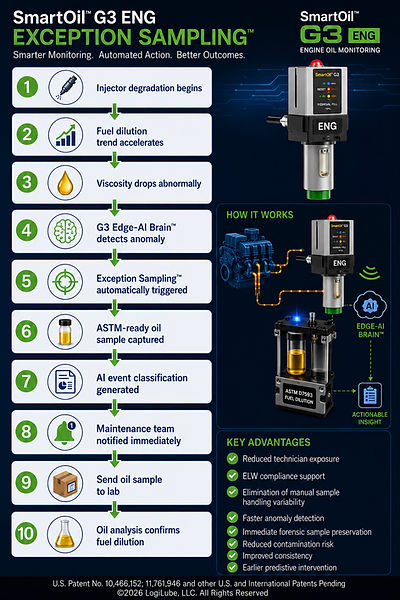
Diesel engine reliability is not coming in the future - It is here now and it's called SmartOil G3™. Predictive maintenance is no longer just periodic inspection and reliance on several week's old sample information. Leading maintenance managers now rely on intelligent autonomous systems capable of understanding the fluid itself, as it undergoes changes during engine operation. Oil samples from several weeks ago are ancient history, because large amounts of damage could already have happened. Exception sampling, and notification to Maintenance and Operations, is the game changer. The knowledge gained by immediately correlating changes in the fluid with a particular environmental condition, is especially valuable because it may enable prevention of damage across an entire fleet of engines. The knowledge gained by continuous monitoring can be particularly valuable, not just to and operator, but also to an OEM, supplier, or lessor of equipment. An intelligent autonomous system may be the lowest cost "insurance plan" available to all parties.
SmartOil G3™ technology is protected by U.S. Patent No. 10,466,152; 11,761,946; 12,681,003; International Patents, and other U.S. and International Patents Pending
Copyright ©2026 LogiLube, LLC