
News & Articles
Varnish: From Data to Decisions: Building the Intelligence Behind Adaptive Dosing (Part 2 of 3)
Article by William Gillette (LogiLube, LLC)
Installing a fluid sensor is relatively straightforward. Determining what this data means and whether that data justifies adding treatment chemistry is considerably more challenging.
The oil in a hydraulic reservoir changes continuously. The oil temperature rises after startup and falls during idle periods. The viscosity changes with temperature and shear history. Additionally, water may enter through breathers, condensation, coolers or washdown. New hydraulic oil is added during ‘top up’ events to compensate for leaks and routine sampling. In addition, filters are changed, components wear and antioxidants are consumed. In this reservoir, oxidation products move between dissolved, suspended and deposited states, these are the three states of varnish.

Two distinctly different application profiles must be considered when designing a varnish-control strategy.
The first is a large, closed-loop system with a relatively stable reservoir volume, such as a utility scale power generation turbine. Once the oil has been treated for varnish-control with Fluitec’s DECON™ at the approved concentration, typically 3% to 5% by volume, the system may remain stable for an extended period and require little or no additional treatment for years. Fluitec describes this long-term stabilization approach as Fill4Life™.
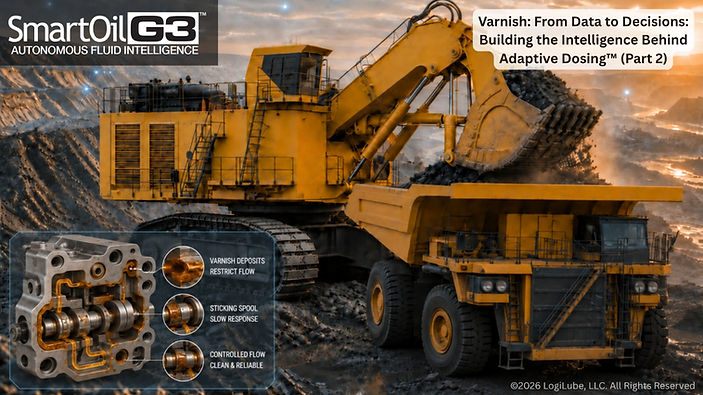
The second application is far more dynamic. In mobile hydraulic equipment (such as hydraulic excavators used in mining) and other systems subject to frequent filter changes, oil leaks, short-interval oil sampling, component replacement and partial reservoir drains, the total oil volume and treatment concentration can change continuously. This article focuses on this second, more dynamic application.
A reservoir drain does not necessarily remove all the system oil retained in pumps, valves, cylinders, hoses, coolers and other circuit components. In fact, new hydraulic oil is often mixed with approximately 30% aged or varnish-contaminated fluid unless the entire hydraulic system is thoroughly flushed and/or physically cleaned.
The resulting blend of new and contaminated fluid must be evaluated for varnish potential, and antioxidant condition. This is where the SmartOil G3 DOSE™ and G3 Edge-AI Brain™ provide the greatest value: continuously accounting for fluid condition, oil additions, losses and operating history, then applying dynamic Adaptive Dosing™ to restore and maintain the hydraulic fluid within its approved performance envelope.
In particular, one hydraulic OEM with excavators at work in the oil sands industry has a typical hydraulic system of approximately 11,500 liters. However, the reservoir accounts for around 7,750 liters. As such, when the hydraulic oil is drained from the reservoir, roughly 30% of the contaminated oil (found in the hoses, etc.) is still in the system.
Against that moving background, a varnish-control system must answer a deceptively simple question:
Does this fluid need treatment now?
A fixed calendar sampling schedule cannot answer this question. Neither can a single alarm limit as this is a layered, complex question which requires validation of various conditions and their effects.
Every reservoir needs its own baseline
The intelligence behind SmartOil G3™ Adaptive Dosing™ begins with baselining.
After installation, the system observes the oil and machine through representative operating cycles. It learns how selected fluid properties behave during cold starts, normal production, peak load, shutdown and restart periods. It records the relationship between temperature and viscosity, the normal dielectric trend, pressure and flow behavior, and the rate at which the fluid changes with operating hours and system conditions.
This baseline is not a universal condemnation limit. It is the normal signature of a particular oil in that specified machine. Therefore, it is imperative to have this baseline established as all results will be compared against these values.
That distinction is critical because two reservoirs using the same ISO viscosity grade may age differently especially as it relates to application and small changes in the environment. A mining excavator may operate through large ambient-temperature swings, dust, shock loads and frequent oil makeup. A paper-machine hydraulic system may experience continuous heat, water ingress and servo-valve sensitivity. Each of these applications require different responses due to their environment.
The correct response depends on context.
SmartOil G3 can combine online measurements such as viscosity, dielectric properties, density, temperature, pressure, water-related response and particulate behavior with machine information such as load, operating hours, start cycles and reservoir level. The G3 Edge-AI Brain™ evaluates absolute values, but it can also evaluate slopes, correlations and departures from the learned profile.
LogiLube’s patent disclosures describe monitoring hydraulic fluids and other machine fluids, combining multiple fluid-property measurements, using edge-based algorithms and defining actions based on monitored conditions and determination also known as remaining useful life (RUL).

Why rate of change matters
Rate of change often provides the earliest warning.
A small dielectric shift may not be significant during a temperature transition. The same shift, repeated under stable operating conditions and accompanied by an abnormal viscosity or temperature trend, may be meaningful.
A rising particle count following maintenance may indicate disturbed contamination rather than varnish. A persistent increase in soft-contaminant behavior combined with declining antioxidant reserve presents a different picture. Particle Count is usually measured using the ISO 4406 test. An ISO 4406 particle counter is part of the system used as shown below in figure 3.
.png)
The purpose of sensor fusion is not to manufacture a single magical number. It is to reduce uncertainty through a larger dataset.
Laboratory analysis remains the reference point for important varnish decisions. ASTM D7843 Membrane Patch Colorimetry extracts insoluble contaminants from in-service hydraulic oil onto a membrane and reports the color difference as a ΔE value. ASTM describes the result as a condition-monitoring trend rather than a stand-alone verdict.
ASTM D6971 uses linear sweep voltammetry to measure remaining hindered phenolic and aromatic amine antioxidants in applicable non-zinc turbine oils. ASTM also cautions that the method does not measure every contributor to remaining oil life and should be supported by additional analytical techniques.
That is exactly why a multi-domain approach is required.
A practical confirmation package of the presence of varnish may include MPC, RULER-type antioxidant testing, viscosity, acid number, FTIR oxidation indicators, particle count, water, air release and elemental analysis. The used oil analysis test slate should match the fluid formulation and application.
Zinc-containing anti-wear hydraulic oils, zinc-free fluids, turbine oils and phosphate-ester control fluids do not all require the same interpretation. Fluitec similarly recommends combining MPC and antioxidant testing with supporting analyses when evaluating hydraulic-fluid degradation and deposit formation.
Capturing the condition while it exists
SmartOil G3 Exception Sampling™ couples continuous monitoring of the hydraulic fluid to laboratory analysis results from physical oil sample evidence.
When the Edge-AI model detects an abnormal pattern, the system can collect an in-service sample while the machine is operating and the event is active. The sample is time-correlated with sensor and machine data via a shared date and timestamp.
Instead of receiving a bottle labeled only with an asset number and sample date, the analyst can evaluate the fluid against the conditions that triggered collection.
This creates a five-stage decision architecture.

1. Observe
The system continuously monitors the fluid and its operating context.
2. Detect
Edge analytics identify a deviation, abnormal slope or combination of sensor data associated with oil degradation or deposit risk.
3. Confirm
The system may trigger Exception Sampling™, request laboratory testing or require operator review, depending on the maturity of the application model.
4. Act
When the decision logic is satisfied, the G3 DOSE™ module delivers a bounded quantity of the approved Fluitec DECON™ formulation.
5. Verify
The Exception Sample is sent to the lab to corroborate the digital data with ASTM standards. The system watches the post-dose response, records the delivered volume and determines whether the oil is moving back toward the target envelope.
Verification is what separates adaptive dosing from automatic pumping.
The importance of dosing guardrails
An ungoverned pump can add fluid but an ‘adaptive system’ must maintain an auditable mass balance.

It should know the reservoir’s working volume, the concentration already delivered, oil added or removed since the previous dose, expected mixing time, allowable dose per event and maximum approved cumulative treatment.
It should also recognize conditions that prohibit dosing. These may include low reservoir level, sensor disagreement, abnormal water contamination, an incompatible oil change, a communication fault or a machine state that does not provide adequate circulation.
Fluitec states that conventional DECON treatment is commonly added at approximately 3% to 5% of hydraulic system volume for cleaning varnish-contaminated lubrication systems. Adaptive Dosing does not mean exceeding an approved treatment range. It means dividing a validated treatment strategy into controlled increments and stopping when the fluid response shows that the objective has been reached.
Product selection matters as much as quantity.
Fluitec identifies DECON™ AW for conventional anti-wear hydraulic oils and DECON™ ZF for zinc-free or ashless hydraulic oils. Other DECON formulations are intended for different lubricant types and viscosity ranges. Before commissioning, the oil formulation, seals, coatings, filtration system, reservoir materials and OEM requirements should be reviewed.
A treatment that is chemically appropriate for one hydraulic fluid should not automatically be assumed appropriate for every fluid.
A staged path to autonomy
The dosing model should initially be conservative.
During a pilot, SmartOil G3 can operate in advisory mode. It monitors, predicts and recommends a dose, while a reliability engineer approves the action. The team compares predicted need with laboratory results and observes the machine’s response.
Once enough data has demonstrated repeatability, the system can progress to supervised automation and eventually to bounded autonomous operation.
This staged approach also improves the algorithm. Every dose becomes a controlled experiment. The system records the starting condition, delivered quantity, circulation time and resulting changes.
Over time, it learns how quickly the specific reservoir responds, how operating severity affects treatment demand and how long the fluid remains inside the target range.
The result is not merely better dosing. It is a digital treatment history for the oil.
That history can answer questions conventional maintenance records cannot:
-
Did treatment demand increase after a cooler problem?
-
Did a particular operating mode accelerate antioxidant depletion?
-
Did the MPC trend improve without adversely affecting viscosity, air release or filtration?
-
Is one machine degrading oil faster than otherwise similar assets?
At fleet scale, these comparisons become powerful. Mining companies can identify excavators or drills with abnormal fluid stress. Paper mills can compare hydraulic systems across machines.
The G3 Edge-AI Brain can use local data for immediate control while fleet analytics identify broader reliability patterns.
Adaptive Dosing therefore depends on disciplined restraint. The system must resist dosing when evidence is incomplete, require confirmation when risk is high and verify every intervention.
Its value comes from precision, not activity.
In Part 3, we move from control architecture to the operating environment and examine how condition-based varnish control can create measurable value across paper machines, turbines and severe-duty mining hydraulics.
Learn more here: https://www.logilube.com/adaptive-dosing
Copyright ©2026 LogiLube, LLC